About
I am a Ph.D. candidate in the School of Computing and Information Science at the University of Maine, where I work with Dr. Torsten Hahmann at the Spatial Knowledge and Artificial Intelligence (SKAI) Lab. My research lies at the intersection of information extraction from text, ontology engineering, and knowledge representation.
I develop CelloGraph, a knowledge discovery system that extracts and structures information about cellulosic materials from scientific publications. The project supports automated knowledge extraction and semantic integration and is funded by USDA NIFA & ARS and the U.S. Forest Service.
Research interests: Natural language processing, machine learning, ontology engineering, knowledge representation, and trustworthy knowledge graphs.
Education
- Ph.D., Spatial Information Science and Engineering, University of Maine, Expected February 2027
- M.S., Computer Science, American International University—Bangladesh, 2020
- B.S., Computer Science and Engineering, American International University—Bangladesh, 2014
Awards and Fellowships
- Future Faculty Fellows, University of Maine, Spring 2026
- Summa Cum Laude distinction for the M.S. in Computer Science
Research Projects
-
CelloGraph (Ongoing):
A knowledge graph system that transforms scientific literature on cellulosic materials into structured and accessible knowledge.
It integrates automated information extraction, ontology-based representation, and expert review while preserving links to
source evidence and annotation histories. The resulting knowledge graph enables researchers to explore domain entities in context,
trace their origins, and examine how extracted information was evaluated and revised. The following research projects contribute
to the development of CelloGraph.
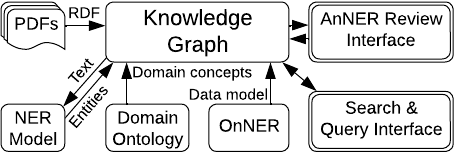
Figure: High-level architecture of CelloGraph. -
Ontology-Guided NER for Cellulosic Materials (Ongoing):
Investigating named entity recognition in scientific publications using transformer-based models and large language models.
The study compares extraction performance and explores ontology-guided validation and refinement of predicted entities
to identify and reduce classification errors and semantic inconsistencies.
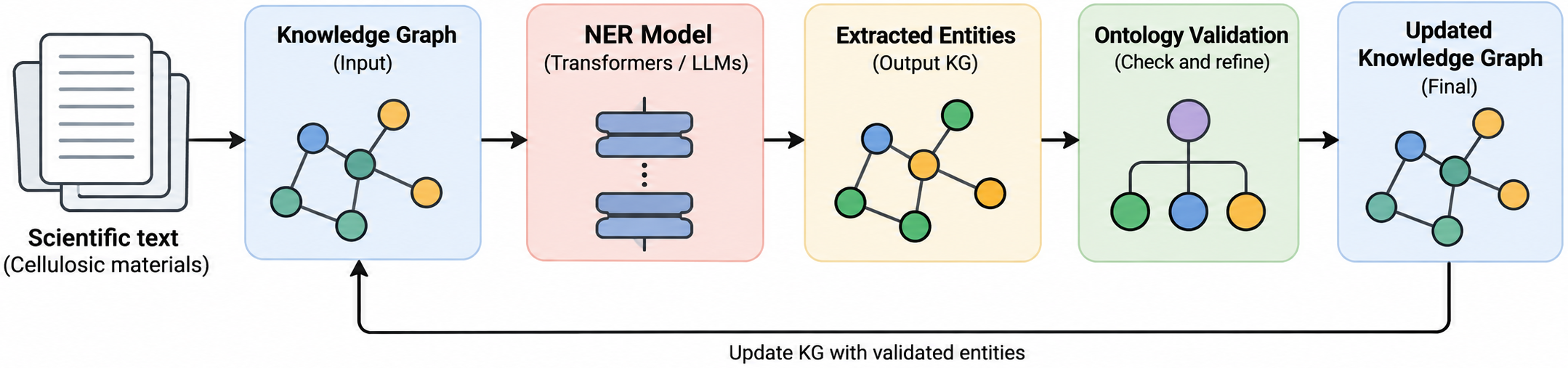
Figure: Proposed ontology-guided NER workflow. -
OnNER:
An ontology for the semantic representation of named entities extracted from scholarly publications. It models entities,
their labels, textual locations, and relationships to document structures, while supporting nested entities and tracking
annotation statuses, revisions, and labeling provenance. By aligning with established ontologies such as BFO, IAO,
and SPAR, OnNER enables interoperable knowledge representation and advanced semantic querying of entity occurrences,
co-occurrences, and contextual information across scientific publications.
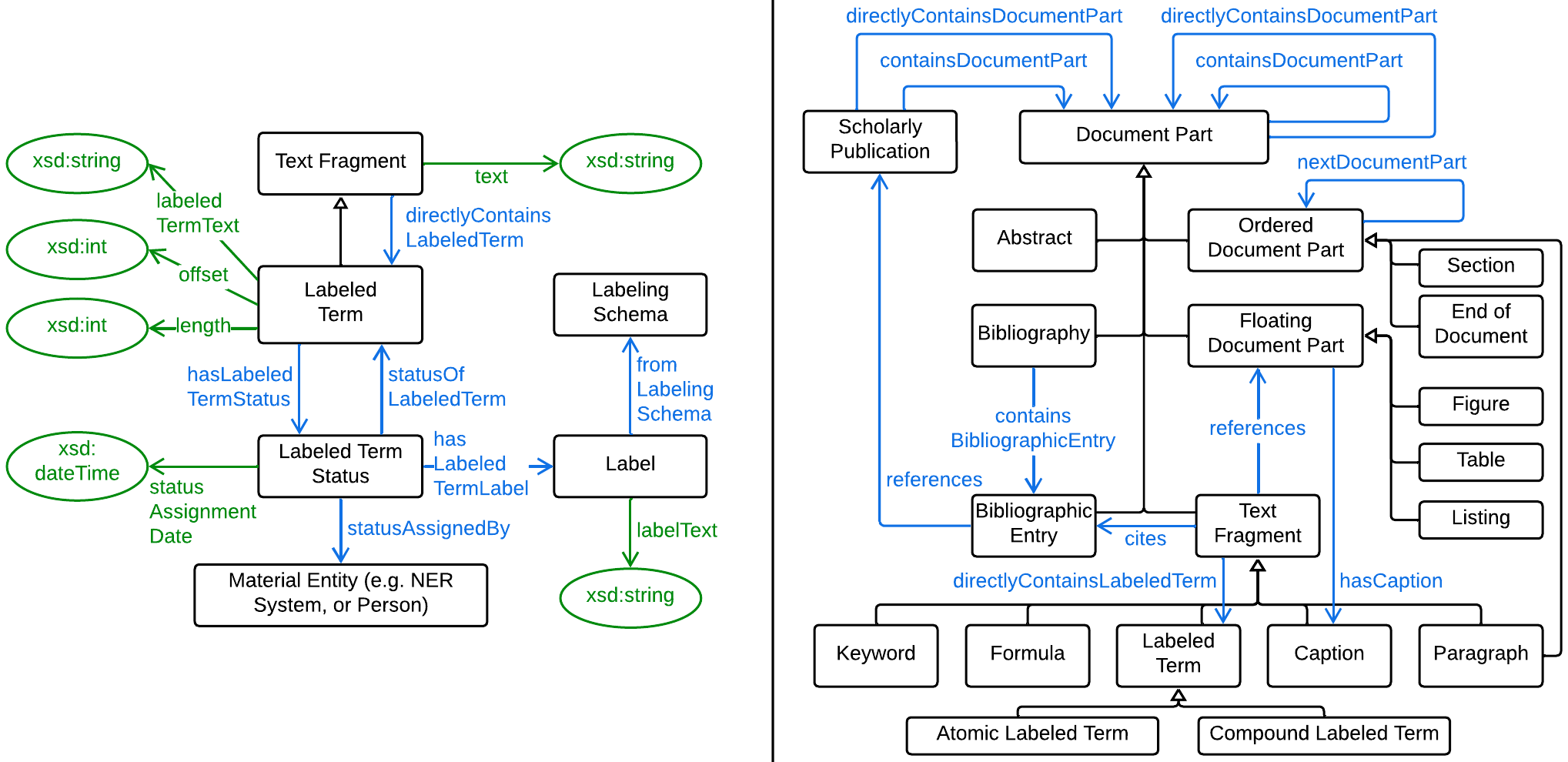
Figure: Overview of the OnNER ontology. -
AnNER:
An open-source, web-based tool for annotating and reviewing named entities in scientific and domain-specific texts.
It supports manual and machine-generated annotations, allowing domain experts to accept, reject, revise, or
suggest entities through an interactive review interface. AnNER preserves complete annotation and review histories,
including labels, statuses, annotators, and timestamps, using a structured JSON-based model. It also supports
exporting annotations and their provenance as RDF aligned with OnNER, enabling traceable knowledge graph construction
and downstream querying and machine learning tasks.
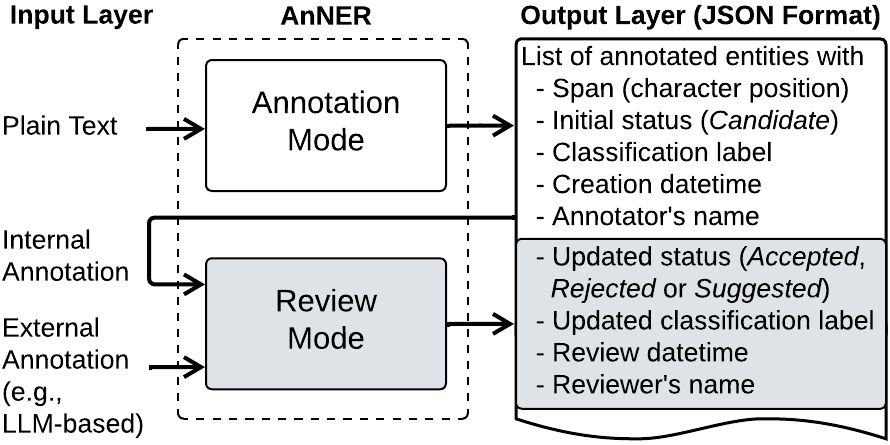
Figure: AnNER's annotation and review workflow. 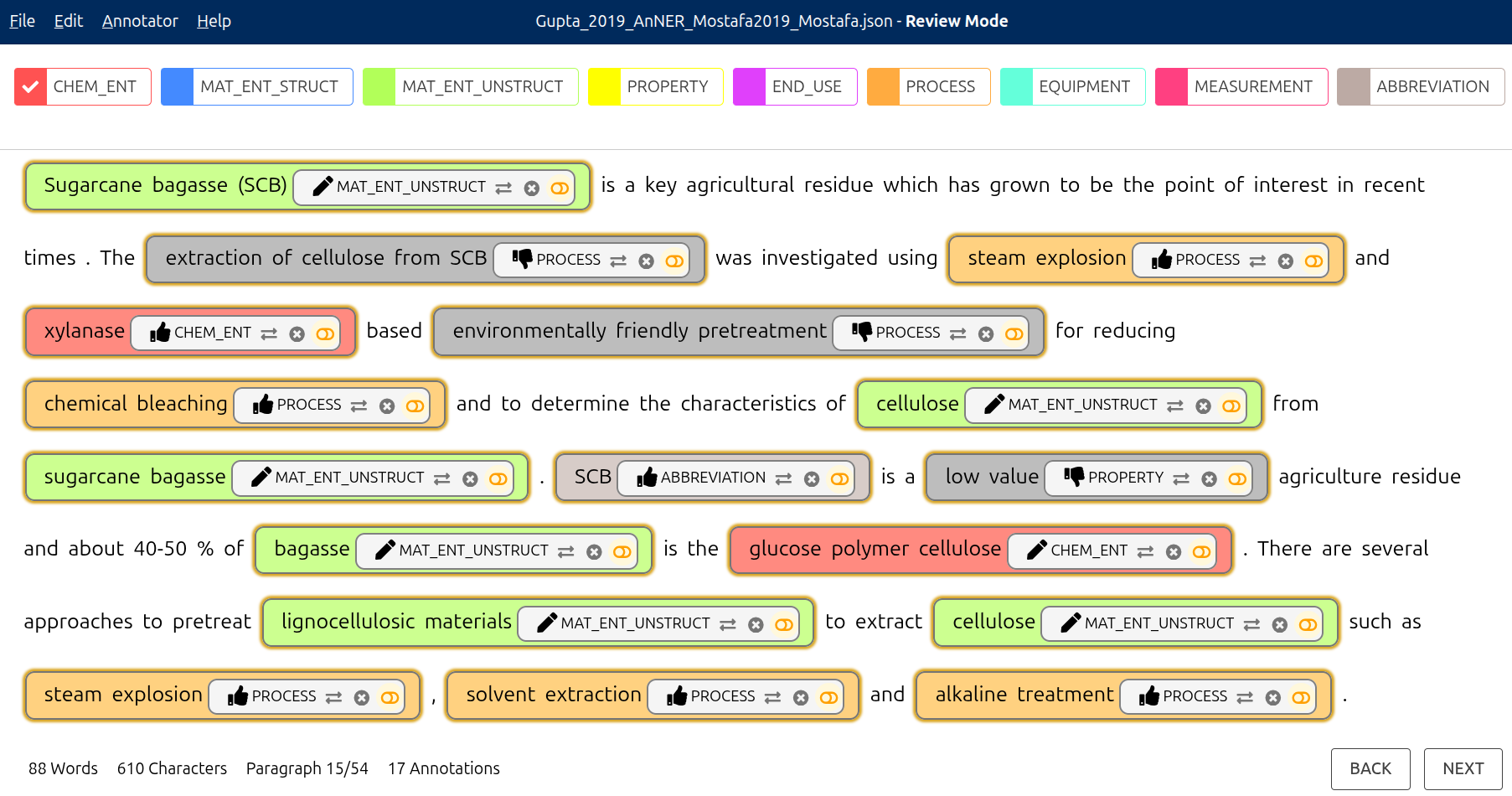
Figure: AnNER's expert review interface for validating and revising entity annotations. -
Provenance-Aware Knowledge Graph Construction
and Querying:
A framework that integrates AnNER and OnNER to represent, review, and query domain entities extracted from scientific
publications. It captures entity annotations together with their textual context, classification labels, review statuses,
annotators, timestamps, and complete revision histories. Through RDF-based knowledge representation and SPARQL
querying, the framework enables researchers to trace annotation decisions, identify inconsistencies, and
investigate how entities were extracted and validated. Its practical utility is demonstrated through CelloGraph,
a knowledge graph for cellulosic materials research.
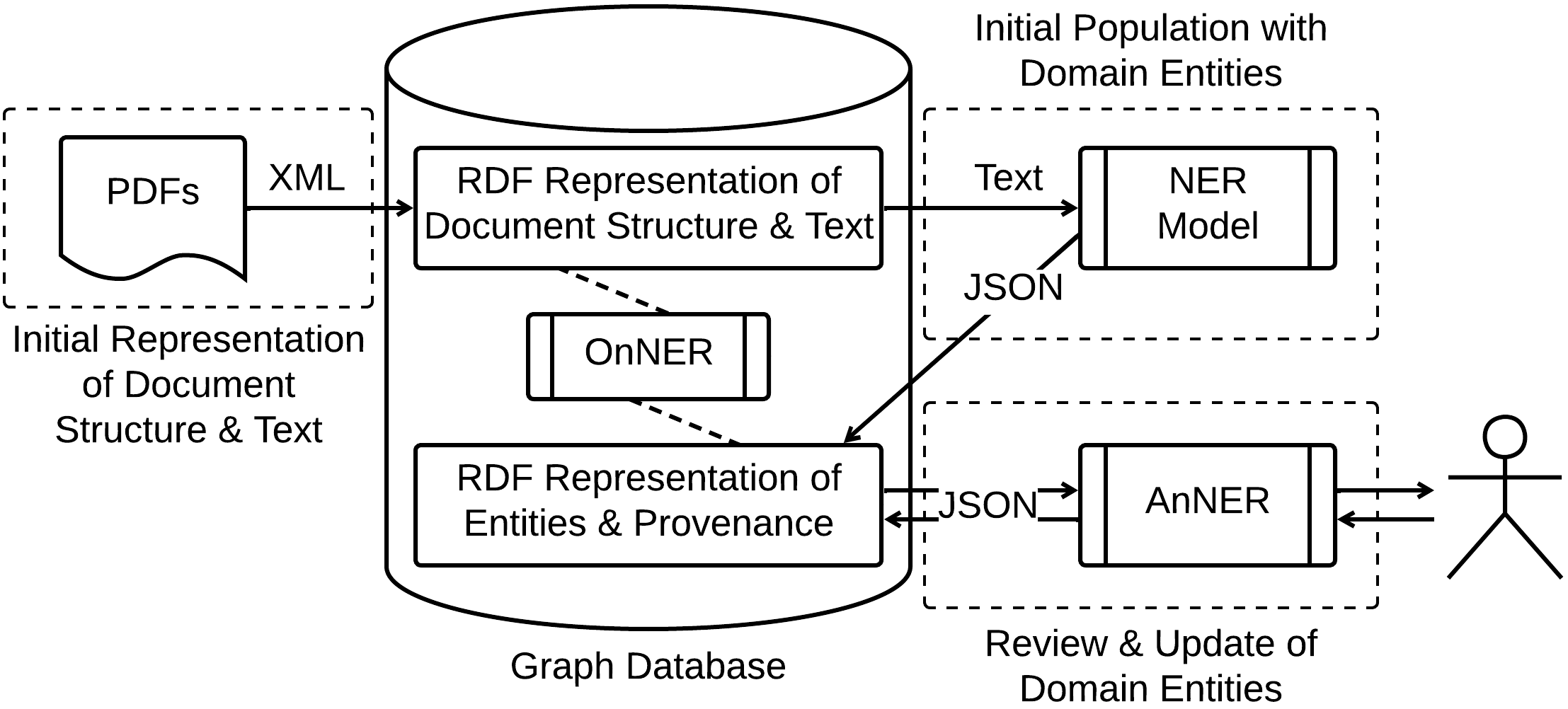
Figure: Overview of the AnNER-OnNER pipeline for provenance-aware knowledge graph construction.
Publications
- U. Reza, T. Hahmann, and J. Wang. A Provenance-Aware Approach for Representing and Querying Domain Entities in Knowledge Graphs. In: Proceedings of FOIS 2026 Satellite events co-located with the 16th International Conference on Formal Ontology in Information Systems (FOIS 2026), Vitória, Brazil, September 2026. PDF
- U. Reza, N. Pease, J. Wang, and T. Hahmann. AnNER: Supporting Efficient Entity Annotation and Review Workflows for Knowledge Graph Construction. In: Proceedings of the 13th International Conference on Knowledge Capture (K-CAP 2025), Dayton, Ohio, USA, December 2025. PDF · GitHub · Try AnNER
- U. Reza, X. Zhang, and T. Hahmann. OnNER: An Ontology for Semantic Representation of Named Entities in Scholarly Publications. In: Proceedings of the 14th International Conference on Formal Ontology in Information Systems (FOIS 2024), Enschede, Netherlands, July 2024. PDF · GitHub · Documentation
- U. Reza and T. Hahmann. Populating and Refining an Ontology of Cellulose Materials with Terms from Scientific Publications: Extended Abstract. FOIS 2023 Early Career Symposium. In: Proceedings of the 9th Joint Ontology Workshops (JOWO 2023) co-located with FOIS 2023, Sherbrooke, Quebec, Canada, July 2023. PDF
Presentations
-
CelloGraph – A Knowledge Graph System for Cellulosic Materials.
Prototype demonstrated at USDA Forest Products Laboratory 2026 · PDF -
AnNER: Supporting Efficient Entity Annotation and Review Workflows for Knowledge Graph Construction.
Paper presented at K-CAP 2025 · PDF -
AnNER and OnNER: Key Components in the Trustworthy Knowledge Graph Construction Pipeline.
Poster presentation · US2TS 2025 · PDF -
Populating and Refining an Ontology of Cellulose Materials with Terms from Scientific Publications.
Poster presented at FOIS 2023 · PDF -
The Scientific Publication Ontology (SciPub): Linking publications’ content to the domain ontologies.
Poster presented at UMaine Student Symposium 2023 · PDF -
CelloGraph – Accelerating Knowledge Discovery for Cellulosic Materials using AI and Knowledge Graphs.
Poster presented at Manufacturing RENEW3D 2022 · PDF